> For the complete documentation index, see [llms.txt](https://docs.langstack.com/welcome/llms.txt). Markdown versions of documentation pages are available by appending `.md` to page URLs; this page is available as [Markdown](https://docs.langstack.com/welcome/get-started/learn-langstack/introduction-to-etl-pipeline/exercise-1-skip-customer-records/step-3-store-skipped-records-in-a-list.md).
# Step 3: Store skipped records in a list
Before storing skipped records in an entity, the records need to be stored in a list. In this exercise, the deleted records details are stored in a variable in the “On Skipped record” section that will be used to create a record in the “On Completed” section.
* To define a variable to hold the skipped records, go to the “Variables” tab.
* In the “Variables” tab, add and define a variable as follows: \
Name: “skippedRecordsList”, Data type: “csvtoentity”, Select “List”.
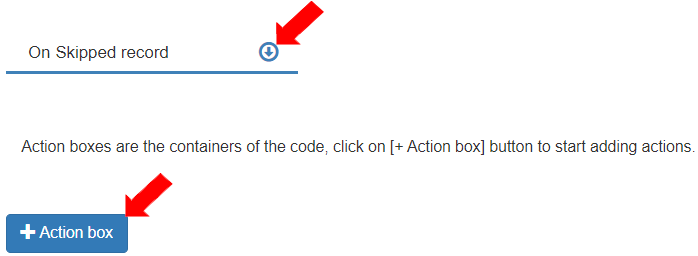
* To define the actions to be executed for the records that are skipped, go to the “Code” tab>“On Skipped record” section.\
To add an “Action box” in the “On Skipped record” section, click the \[+ Action box] button.
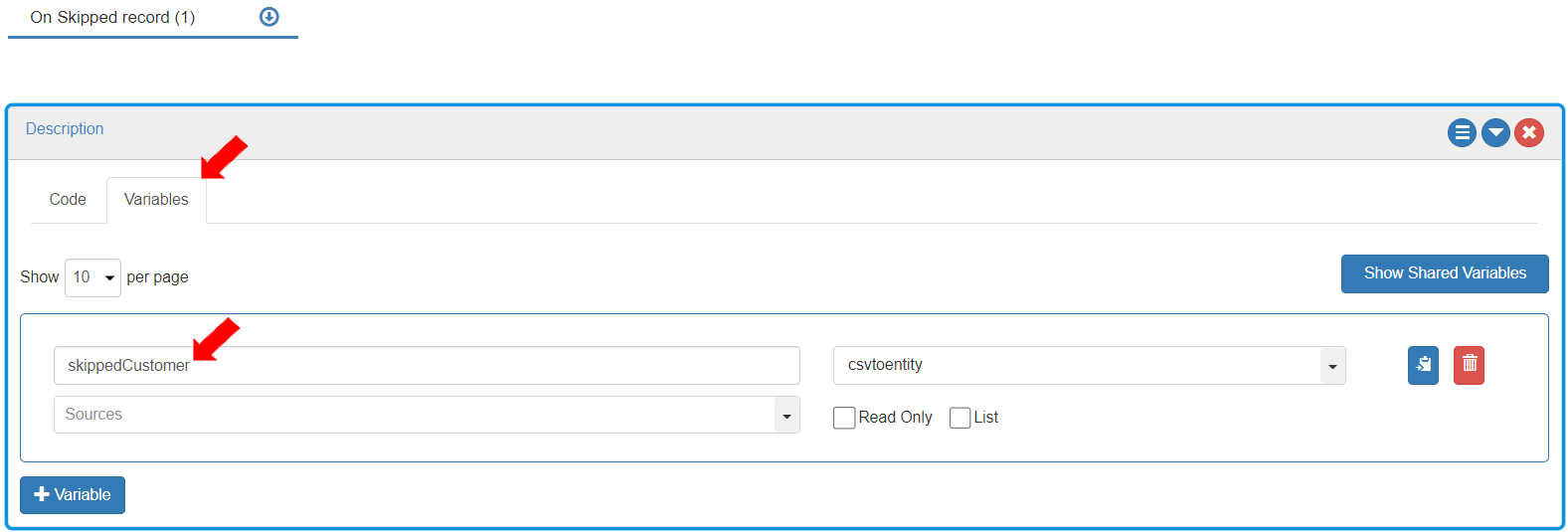
* All shared variables can be displayed in the Action box>Variables tab by clicking the \[Show Shared Variables]button.
* To store the skipped record in a variable before updating it in the target entity, add a new variable as follows:\
Variable name: “skippedCustomer”, Data type: “csvtoentity”.
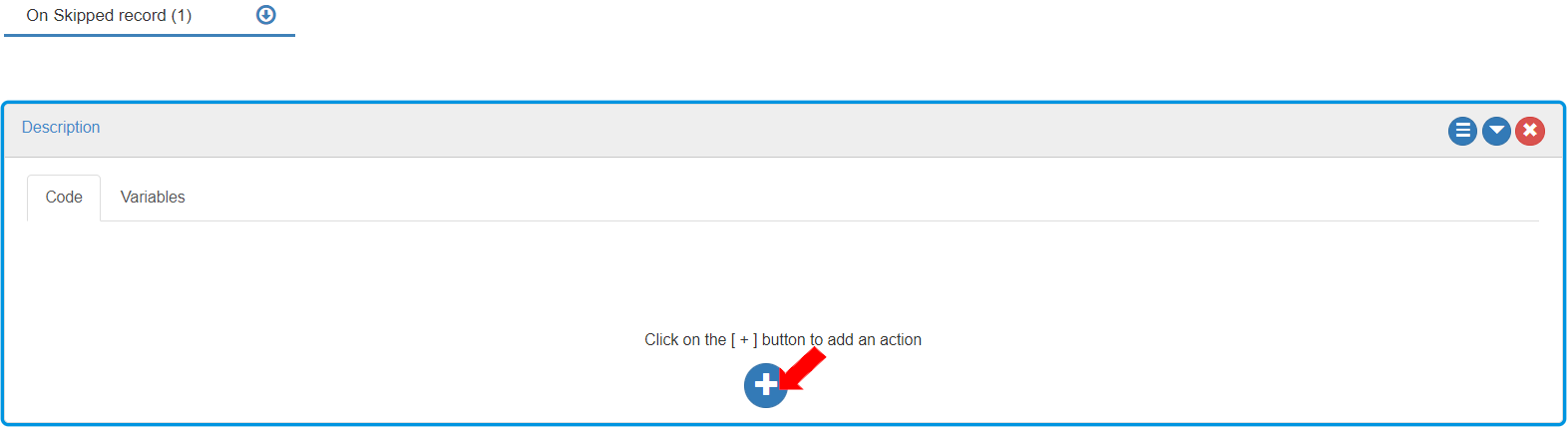
* To add Actions, go to the “Code” tab and add two (2) Actions.
* Define the first Action as follows:
* Action: “Update Variable”
* Target Value: “skippedCustomer.Message”
* Update the Source with multiple values as follows:
1. Enter the constant text as “Customer\_ID ”.
2. Select variable as “skipped.Customer\_ID”.
3. Enter the constant text as “ was skipped due to the following reason: ”
4. Select variable as “skippedReason”. \
(The reason for the selected Customer\_ID to be skipped is stated)
* Define the second Action as follows:
* Action: “Add Item to List”
* Target Value: “skippedRecordsList”
* Source: “skippedCustomer” (add skipped records to list)